- Valley Recap
- Posts
- ☁ NEOCLOUD SUMMIT: Where the Next Cloud gets BUILT 💰 Bay Area Startups Collectively Secured $3.7B in September Week 1 🇺🇸 Happy Labor Day
☁ NEOCLOUD SUMMIT: Where the Next Cloud gets BUILT 💰 Bay Area Startups Collectively Secured $3.7B in September Week 1 🇺🇸 Happy Labor Day

In partnership with


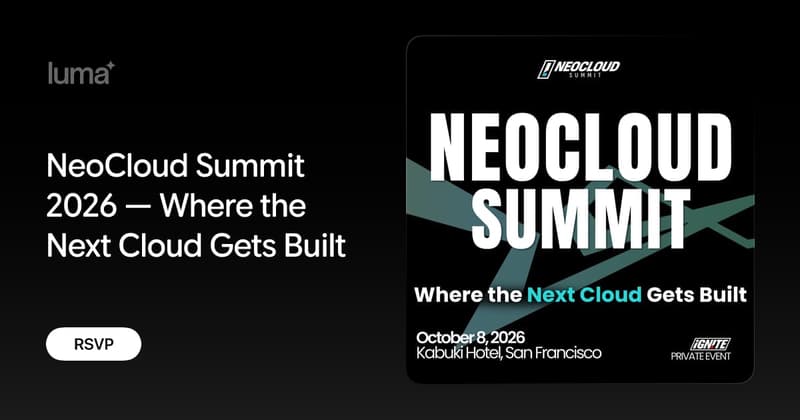
Where the Next Cloud Gets Built
Neoclouds sit at the center of the AI infrastructure universe. Where our AI Infra Summit (DEC3) takes the wide lens across providers, developers, and enterprise buyers. NeoCloud Summit does something different. It is a focused conversation about neocloud systems and everything that touches them: the layers below, above, and around the operators building AI-native capacity.

This is where the next cloud gets built. And right now, nobody has it fully figured out.
Supply chains are fragmented. Partnerships are still forming and reforming. The economics are being priced faster than anyone fully understands them. This is a frontier ecosystem, and frontier ecosystems do not get solved by one company in a room alone. They get worked out when the people building them compare notes in the same place at the same time. That is why we bring this together.
It is also why we build the program the way we do. We do not curate a lineup a year in advance and fill a stage with logos. We build around what is actually salient right now, so the conversations on stage match the ones the market is having this quarter. On a topic moving this fast, relevance is the whole point.

Here is some of what the day digs into:
What is actually changing. The constraint has moved beyond GPU availability. Cooling, land, financing, supply chain, and deployment timing now shape outcomes as much as chips do. The market is evolving from H100-era buildouts toward Rubin-era infrastructure, and the pace of that change is forcing new decisions across the entire stack.
The financing question. Everyone is raising and building. Fewer are talking openly about the unit economics underneath it: GPU depreciation, the capital stack, and what holds up if utilization or pricing softens. Tied to it is utilization itself, the difference between having GPUs and having GPUs that actually earn. This is one of the least-discussed and most important conversations in the space.
Why neoclouds have to be more than bare metal. If everyone is renting the same GPUs, what keeps neoclouds from becoming interchangeable? The strongest operators build a full stack and differentiate on reliability, service design, and knowing the customer workload, not simply on having capacity.
The shift to inference. The money is moving from training to inference, and inference has completely different infrastructure requirements: latency, locality, cost per token. Neoclouds optimized for training buildouts may be pointed at the wrong workload, and that gap is opening in real time.
What enterprises actually want. The buyers close the day. The real reason enterprise AI stalls is not compute. It is trust: security, reliability, and integration into existing environments that are already messy. Buyers do not want capacity. They want outcomes they can run in production.

The throughline is simple. The winners over the next 6 to 12 months will pair capital and GPUs with differentiated operations, targeted products, and infrastructure people trust. Everyone else will be counting GPUs.
If you build, buy, fund, or power neoclouds, this is the most relevant AI infrastructure conversation you can be in this year. That is what we are building on October 8.


Bay Area Startups Collectively Secured $3.7B in September Week 1
It was a slow week, the lull before Labor Day - but the deals total still broke the $3B mark in an AI-heavy week where five megadeals were 93% of fundings.
If there was any doubt that open-source models will take an increasing percentage of the AI workload, NVIDIA's $13B acquisition of Hugging Face eliminates it. In response to the frontier labs and Big Tech all working towards less dependence on NVIDIA by building their own chips (Anthropic was the last holdout), NVIDIA will invest and ensure that open-source models are a competitive alternative.
Most August funding ever, why and to who? New technology in silicon, power and compute, what to expect as we end Q3 and into Q4. Check us out next Friday, register here.
Startups: Looking for partners or possible competitors? LinkSV's Pulse of the Valley weekday newsletter and alerts can keep you on top of new companies launching; database keyword search gives you prospects for partners and customers. Founders get the newsletter, and alerts for just $7/month ($50 value). Check it out and sign up here.
Follow LinkSV on LinkedIn to get early notice of new tech, stay on top of SV funding intelligence, and keep track of the companies, investors and executives impacting the startup ecosystem.
Early Stage:
Emperik.ai closed a $21M Seed, building the autonomous infrastructure engineer.
Andromeda Surgical closed a $15.1M Series A, developing an autonomous surgery platform.
Visko Platform closed a $10M Pre-Seed, an AI research company pioneering Live Models — a new class of world models that run rather than render.
Robocurve closed a $.5M Pre-Seed, developing open-source evaluation frameworks and independent benchmarking platforms for robots and the AI models that control them.
Growth Stage:
Crusoe closed a $3B Series E, provides a reliable, scalable, cost-effective, and environmentally friendly solution for AI infrastructure.
Gimlet Labs closed a $300M Series B, combines GPUs, near-memory compute, dataflow architectures, and CPUs in one heterogeneous system for 10X gains in throughput.
Lyte AI closed a $165M Series C, designs custom silicon, multimodal sensors, spatial software that give robots and autonomous systems a real-time view of the physical world.
Greptile closed a $40M Series B, an AI expert that understands your codebase, as an API.
Your Feedback Matters!
Your feedback is crucial in helping us refine our content and maintain the newsletter's value for you and your fellow readers. We welcome your suggestions on how we can improve our offering. [email protected]
Logan Lemery
Head of Content // Team Ignite
Blu Dot surpasses 2,000% ROAS with self-serve CTV ads

Home furniture brand Blu Dot blew up on CTV with help from Roku Ads Manager. Here’s how:
After a test campaign reached 211,000 households and achieved 1,010% ROAS, the brand went all in to promote its annual sales event. It removed age and income constraints to expand reach and shifted budget to custom audiences and retargeting, where intent was strongest.
The results speak for themselves. As Blu Dot increased their investment by 10x, ROAS jumped to 2,308% and more page-view conversions surpassed 50,000.
“For CTV campaigns, Roku has been a top performer,” said Claire Folkestad, Paid Media Strategist, Blu Dot. “Comping to our other platforms, we have seen really strong ROAS… and highly efficient CPMs, lower than any other CTV partner we've worked with.”
Using Roku Ads Manager, the campaign moved from a pilot to a permanent performance engine for the brand.